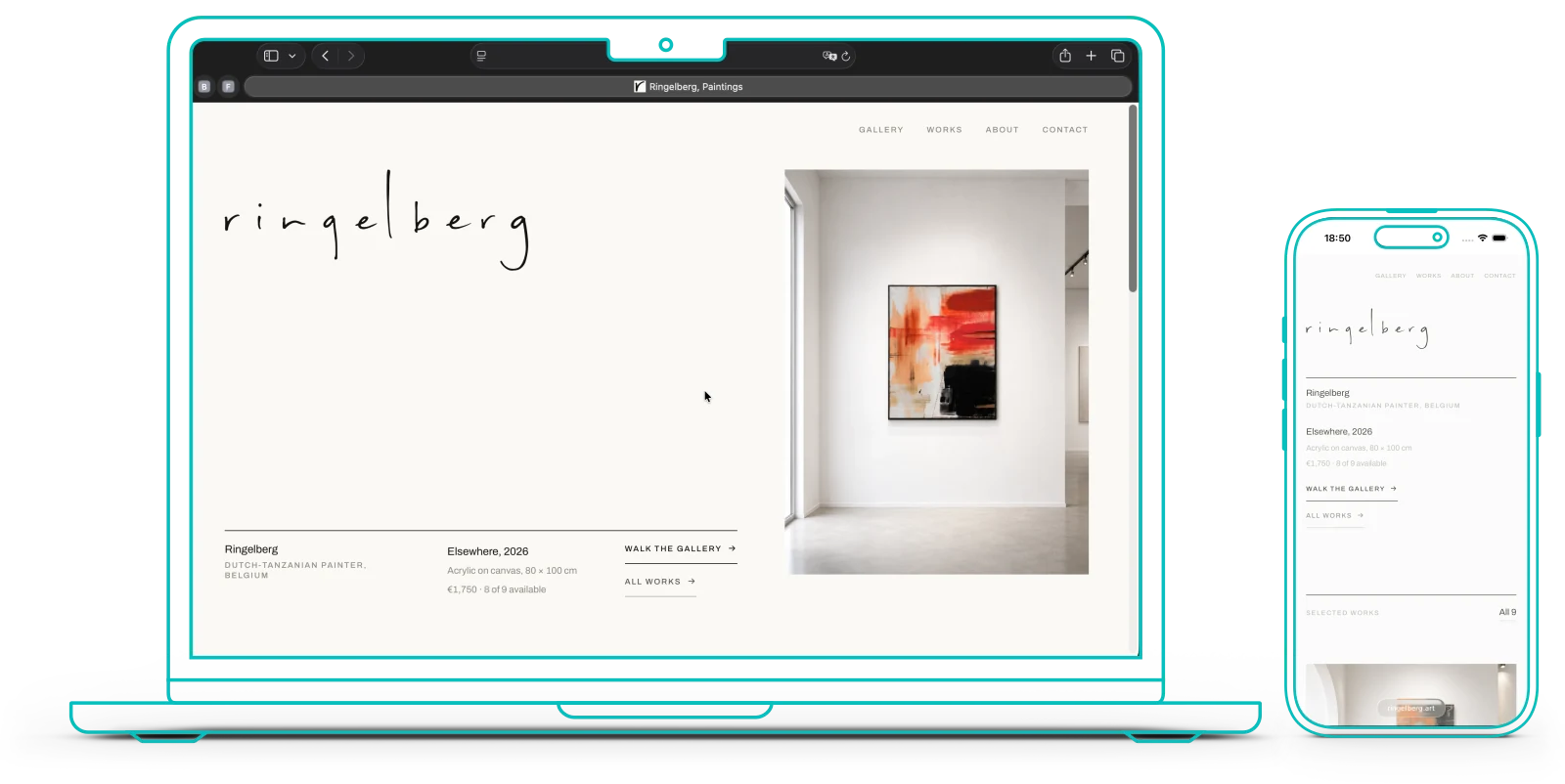
Ringelberg is a Dutch-Tanzanian painter working in Belgium. He wanted to show his work and sell it directly, without the language of a webshop getting between the visitor and the painting. The site had to feel like a room, not a catalogue.
The challenge
Selling original art online is a question of trust before it is a technical one. Someone spending four figures on a canvas wants to know how it hangs on a wall, how big it really is and what they actually receive. At the same time the painter wanted to stay behind his signature, and to change prices and availability himself without going near the code.
Our approach
We skipped the frameworks and kept it lean. Plain JavaScript on Vite, with Three.js loaded only on the page that needs it, so every other page stays fast HTML. For the design we followed gallery rules instead of web rules: no rounded corners, no filled buttons, one typeface, nothing that competes with the paintings. All the work lives in a single data file the painter maintains himself.

The signature
The wordmark writes itself, then gets out of the way.
The wordmark is the painter's own signature. On the front page it draws itself, then travels to the corner of the header as you scroll.
The animation follows the real path of the pen. We rasterised the signature, thinned it down to its centre lines and rebuilt the stroke order offline, so the letters appear the way a hand would set them rather than wiping in from the left.
It plays once on arrival and then steps aside. The paintings are the point, not the effect.
The solution
Four things carry the site: a room you can walk through, a signature that draws itself, photographs shown exactly as the painter took them, and pages a search engine can actually read.
3D gallery
A white room in the browser. The camera glides from canvas to canvas and each painting hangs at its true size in centimetres, so a 40 by 50 reads smaller than an 80 by 100. Click to step closer.
Handwritten wordmark
The signature draws itself along the real centre lines of the pen, traced out of the artwork offline, then moves up to the header as you scroll.
His photographs, untouched
Nothing is cropped or retouched. The site adapts to the photographs instead. In the 3D room the wall takes on the background tone of each shot, so the canvas sits on it without a visible edge.
Built to be found
Every route ships as real HTML with its own share card and structured data, so search engines and AI assistants see the work rather than an empty page.
The result
A site that sells without ever sounding like a shop. Nine canvases with size, price and availability, a signed certificate of authenticity with every sale, and enquiries that reach the painter in one click. He changes a price or marks a painting sold in one file, and the rest of the site follows.
Tech stack
Work that deserves better than a template?
We design and build sites around what you make, from portfolio to platform. Tell us what you have in mind.
Start a conversation